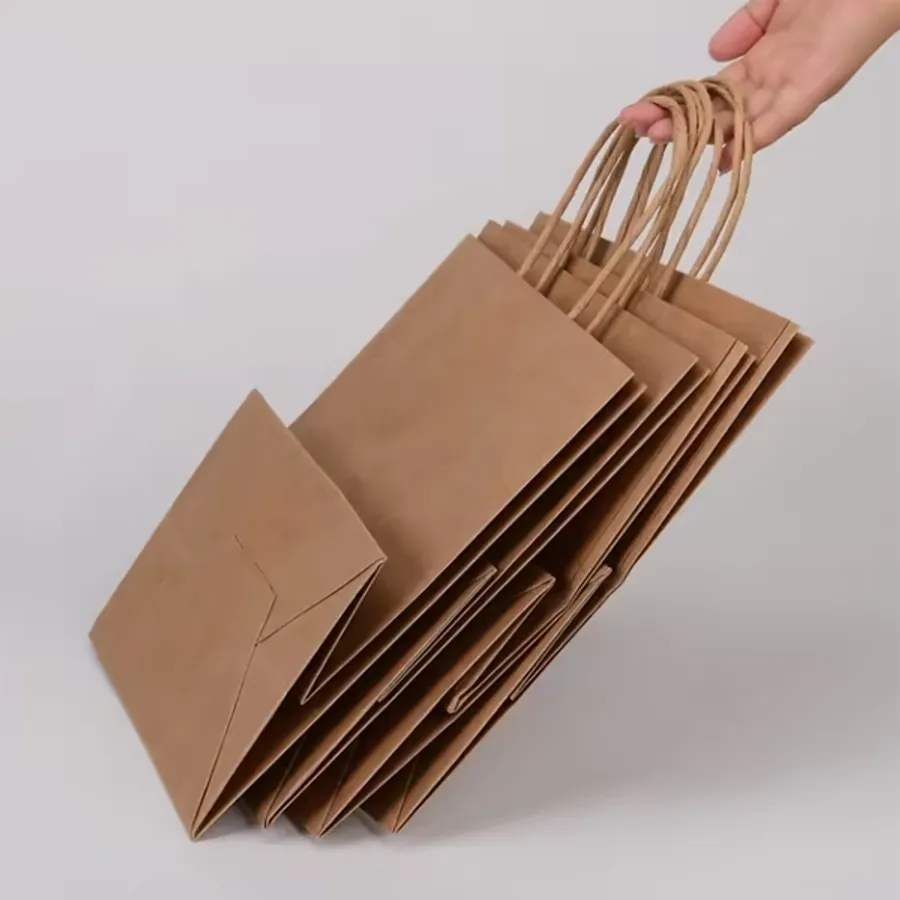
Paper bag guide
Paper Bag Cost Per Unit: What Moves the Price Up or Down
The seven cost drivers behind a paper bag quote, ranked, and the choices that do not change the price
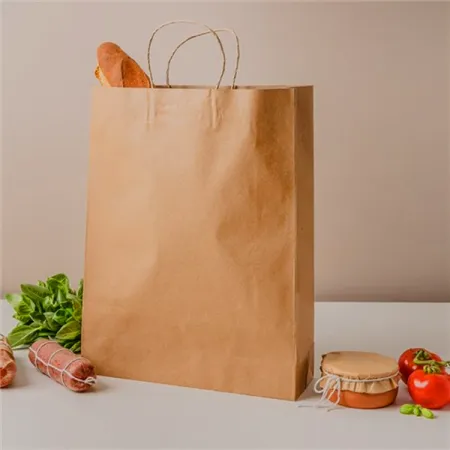
Why is there no single price for a paper bag?
Ask three suppliers for the price of a paper bag and you will get three questions back. How many, what size, printed or plain. The answers can move the unit cost by several times.
That is why our bags are quoted from $0.30 each, with every order confirmed in writing. The starting figure is a plain, common-size bag in a sensible quantity. Everything you add or change moves it from there.
This guide ranks the things that move the price, so you can see where a budget goes and where it does not. None of it replaces a quote, but it tells you which questions matter before you ask.
What are the seven cost drivers, ranked?
The table lists the drivers in the order they usually matter. The first moves the unit price most, the last moves it least. Your order may rank them differently, but the pattern holds for most bags.
| Rank | Driver | Why it matters | Cheapest end |
|---|---|---|---|
| 1 | Quantity | Setup is spread over every bag in the run | A larger run, ordered less often |
| 2 | Bag size | More paper and a bigger press sheet per bag | The smallest bag that fits the contents |
| 3 | Print colors | Each ink is a plate, a pass and a wash-up | Plain, then one color on one side |
| 4 | Paper type and weight | Coated and heavy sheets cost more per bag | Natural kraft at the lightest weight that works |
| 5 | Handle type | Rope and ribbon are fitted by hand | No handle, then flat or twisted paper |
| 6 | Finishes | Lamination, foil and spot UV are extra passes | Uncoated, no finish |
| 7 | Extras | Windows, card bases, header cards, tin ties | None |
Why does quantity matter more than anything else?
Every printed order carries fixed work: checking the artwork, making the plate, setting the press, washing it down afterward. That work costs the same for 500 bags as for 5,000.
Spread over 500 bags, the setup is a large slice of each unit. Spread over 5,000, it is a sliver. The paper and the ink per bag barely change, so the unit price falls as the run grows.
The curve flattens eventually. Once a run is long enough, the setup slice is already small and a bigger order saves little more per bag. That point is different for each bag, and the quote shows it when you ask for several quantities.
Ordering more is not always right. Storage, cash flow and the risk of a logo change all pull the other way. Our guide to working out order quantity balances those against the price.
A reorder example, without the numbers
Here is how the quantity effect plays out for a real kind of customer. A new café orders a small first run, likes the bags and reorders larger. The unit price moves at each step, and the reasons are listed in order.
- The first order is 1,000 one-color kraft bags. Setup, plate and proof are new, so the unit price sits at the top of the range for that bag.
- The café sells well and reorders 3,000 of the same bag. The artwork is already on file and approved, so no proof round is needed.
- Setup is now spread over three times as many bags. The unit price drops, though the total invoice is higher.
- On the third order the café asks for 5,000 and adds a second size. The two sizes are quoted as separate lines, and the larger line gets the lower unit price.
- A year later it adds a second ink for a tagline. The unit price rises a little on the same quantity, because a new plate and a second pass are added.
- The café then settles on 5,000 bags every quarter. From here on the price only moves with paper costs, not with setup.
How much does printing add to a plain bag?
A plain bag is paper, glue and a handle. Add one color and you add a plate, ink and a press pass. That is the biggest single jump, and every ink after it adds another step.
One color on one side is the most affordable printed bag. The same design on both sides adds a second pass. Two different designs on two sides add a second plate too.
Full color sits at the top. Four inks, tighter registration and usually a smoother paper to carry the dots. On a gift bag that is money well spent. On a grocery sack, it rarely is.
Finishes come after print. Lamination, foil and spot UV each add a separate process, which is why they appear on luxury bags and almost never on food bags. Compare the printed options on our custom printed paper bags page.
Which handle costs the least, and which the most?
Handles rank in a steady order. No handle is cheapest, since the bag is simply folded and glued. Die-cut comes next, because the handle is a hole punched in the top with a little reinforcement.
Flat paper handles and twisted paper handles cost about the same. Both are made by machine and glued in during bag making. Twisted handles are usually a touch more.
Rope handles move up a step. They are threaded through punched holes and knotted or secured by hand inside the top, so labor rises with every bag.
Ribbon handles sit at the top. Ribbon is a bought-in material in a chosen color, fitted by hand. The bags that use it are often coated and laminated as well. Our ribbon handle paper bags show where that spend makes sense.
Does paper choice change the unit price much?
Natural brown kraft is the baseline. White kraft costs slightly more because the pulp is bleached. Recycled-look kraft is close to natural brown, since the look comes from the sheet rather than a process. Plain brown paper bags in every size are the cheapest starting point.
Coated white art paper is a clear step up. It is a heavier, smoother sheet that prints full color well, and it is the paper under most laminated bags.
Weight matters inside each type. Moving from 90 gsm to 120 gsm adds a third more paper to every bag. The price moves less than that, but it moves.
Black and colored papers vary. Some are stocked sheets at a small premium, others are white paper printed in a solid color, which counts as a print pass. The quote says which applies.
What does not change the price?
Buyers sometimes hold back a request because they expect it to cost extra. These items do not change the unit price, so ask for them freely.
- A custom size instead of a standard size. Bags are cut to your measurements either way.
- The design proof, which is free and stays free through the usual round of changes.
- Reusing artwork from an earlier order. The file is already on file and approved.
- Tracked delivery, which is included in the quote for the US, UK, Canada and Australia.
- Splitting a quantity across two sizes, though each line is priced on its own quantity.
- Choosing black ink over another single color. One ink is one ink.
- Asking for several quantities on one quote so you can compare the unit price at each.
How can you bring the unit cost down without a worse bag?
Start with size. The smallest bag that fits the contents with clearance costs less than the next size up and looks better filled.
Then look at color count. A two-color logo often reads just as well in one color, especially on kraft. Ask for the single-color version from your designer.
Print one side unless the bag is reused. Takeout, grocery and bakery bags are carried once and seen from the front, so the back is wasted ink.
Finally, agree a reorder quantity and stick to it. A steady 5,000 every quarter earns a better unit price than four rushed orders. It also keeps artwork and proofs out of the loop. Volume pricing is explained on our wholesale paper bags page.
What should you ask for on the quote?
A quote is only as useful as the comparisons it lets you make. Ask for three quantities, such as 1,000, 2,500 and 5,000, so you can see where the curve flattens for your bag.
Ask for plain and one color as two lines if you are unsure about printing. The gap between them tells you what the logo really costs per bag.
If you are weighing two handle types or two papers, say so. The quote can list both, and the difference is often smaller than expected.
Send the size as width × gusset × height, the quantity, the print and the handle, and the figures come back in writing. Once you approve the proof, the press run takes 4–6 business days.