Paper bag guide
Paper Bag Handle Types Compared
Twisted, flat, rope, ribbon and die-cut handles: what each one carries and costs
Why does the handle matter so much?
The handle is the only part of a paper bag your customer touches for more than a second. If it digs into fingers or looks cheap, that is what they remember.
It also drives cost. Handles add material and a gluing or knotting step. That can move your unit price more than the paper does.
Finally, the handle sets the bag's job. A bag with no handle stays at the counter; a bag with rope handles goes to dinner afterward.
There are six options. The rest of this guide compares them in plain terms, with the bags each one suits.
Six handle types at a glance
Use this table as a quick shortlist. Cost is shown as a rough order from lowest to highest, since exact prices depend on size, paper and quantity.
Comfort here means a short walk with an everyday load. None of these handles come with a weight rating, so tell us what goes in the bag.
| Handle | How it feels | Look | Cost order | Typical bags |
|---|---|---|---|---|
| None | Carried by the body or folded top | Plain, practical | Lowest | Grocery sacks, SOS, lunch, bakery and food bags |
| Die-cut | A hole in the top; firm grip, can pinch | Flat and clean | Low | Event handouts, header card packs, light takeout |
| Flat paper | Wide band; spreads the load | Practical | Low to middle | Carryout, grocery and restaurant bags |
| Twisted paper | Round cord; comfortable | Classic retail | Low to middle | Everyday retail, café and gift bags |
| Rope | Soft, thick cord | Premium | Higher | Apparel, cosmetics, Eurotote and luxury bags |
| Ribbon | Soft, flat fabric | Gift-like | Highest | Gift, jewelry and event bags |
Twisted paper handles: the everyday default
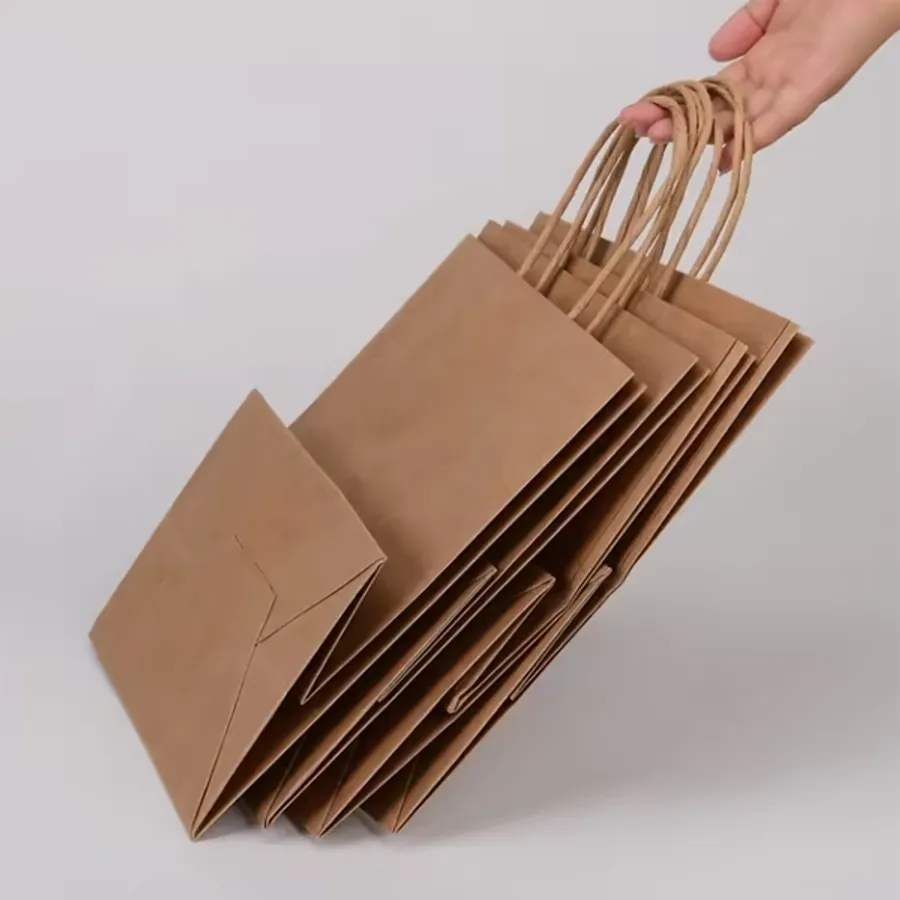
A twisted handle is a tightly twisted paper cord, glued inside the top of the bag. Picture a classic brown kraft shopper and this is the handle you see.
The round cord sits comfortably in the hand on a short walk. It folds flat with the bag, so cartons pack tight and storage stays small.
Twisted handles usually match the bag paper, brown on brown or white on white. Colored twisted handles are possible when you want a small accent.
One thing to watch is the load. Twisted handles carry everyday retail purchases well, but very heavy, wide loads are better on flat handles or rope.
Boutiques, cafés, bookstores and gift shops use them most. Sizes run from about 8 × 4.75 × 10.5 in to 16 × 6 × 12 in. See our twisted handle paper bags for sizes and papers.
When are flat paper handles the better choice?
A flat handle is a folded strip of paper glued inside the top edge as a wide loop. Because the band is wide, it spreads the weight across the palm instead of pressing on one line.
That makes flat handles the favorite for wide carryout bags. Restaurants packing three or four containers, and grocers with heavy orders, pick them for comfort.
Flat handles also sit lower than twisted ones. That keeps the bag shorter overall, which helps in delivery bags stacked in a car or on a rack.
Flat handles are usually glued to the inside of the bag front and back. From the outside you see a neat band, and the print panel below stays clear.
The trade-off is looks. Flat handles read as practical rather than stylish, so fashion stores rarely choose them. Restaurants can compare sizes on our flat handle paper bags page.
What makes rope handles feel premium?
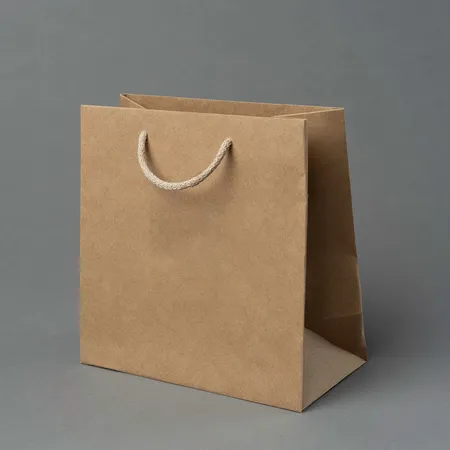
Rope handles are thick, soft cords. They are threaded through holes punched in a folded, reinforced top and knotted inside.
The folded top adds stiffness, so rope handle bags hold their shape on a counter and in a hand. Customers notice that firmness before they notice anything else.
Rope bags usually use heavier kraft or coated art paper, and they are often laminated or foil stamped. Clothing stores, cosmetics brands and wine shops order them most.
They cost more than paper handles because of the cord, the punching and the folding. Many stores use rope bags for full-price sales and keep twisted handles for everyday ones.
Rope comes in many colors. Matching the rope to your logo color is a small detail that makes a plain bag look custom.
Compare colors and papers on our rope handle paper bags page.
Ribbon handles for gifts and events
Ribbon handles are flat fabric loops, often in a satin or grosgrain look. They turn a bag into gift wrap, and customers often tie them together in a bow.
The ribbon color can match your brand or an event palette. Wedding planners and jewelers order them for that reason.
Ribbon drapes rather than holds its shape. Keep it for light contents such as jewelry, cosmetics and small gifts. For bottles or heavy boxes, rope is the steadier choice.
Plan the ribbon color with the bag color. Cream ribbon on kraft looks soft and rustic; black ribbon on white looks formal.
Ribbon tends to be the costliest handle, so it pays off where the bag is part of the present. See our ribbon handle paper bags for colors and sizes.
Die-cut handles and bags with no handle
A die-cut handle is a hole punched through the top of the bag. Nothing is attached, so print can run right up to the hole.
Die-cut bags pack flat and light. Trade shows, fun runs and conferences that hand out hundreds at a time use them. The grip is firm but can pinch on a long carry.
See our die-cut handle paper bags for shapes.
Many bags need no handle at all. Leaving it off is the cheapest option and often the most practical one:
- Grocery sacks loaded straight into a car.
- SOS and lunch bags that fold over at the top.
- Bakery, bread and cookie bags carried in one hand.
- Flat merchandise bags that slip into a purse or tote.
- Food sleeves for fries, sandwiches and pizza slices.
Which paper bag handle costs the least?
No handle is always the lowest cost. Die-cut comes next, because it adds no material, only a cutting step.
Flat and twisted paper handles sit close together in the middle. The bag size and paper matter more than the choice between them.
Rope costs more, and ribbon usually costs the most. Both need extra material plus punching and folding work on the bag top.
Quantity shifts the gaps between them. On a large run, the per-bag gap between rope and twisted paper shrinks. On a small run it shows more.
Changing the handle is often the easiest way to lower a quote without changing your print. Ask for two handle options on the same quote and compare.
Mixing handle types across one store
Few stores need just one handle. Most settle on two: a cheaper handle for daily volume and a dressier one for gifts or high-value sales.
Keep the paper and print the same across both, so the brand reads as one family. A kraft twisted bag and a kraft rope bag with the same logo look planned, not random.
Food businesses mix differently. A café might use no-handle bakery bags at the counter and flat handle bags for delivery orders.
Event teams often pair die-cut bags for handouts with ribbon bags for speakers or VIP guests. The difference in handle tells people which bag is which.
For size pairings that work across handle types, see our paper bag sizes chart.
How do you choose the right handle?
Work through these questions in order. Most buyers have an answer by step three.
If two answers apply, go with the one your customers meet most often. You can always add a second bag later.
- Will the customer carry the bag any distance? If not, consider no handle.
- Is the load heavy or wide, like stacked food containers? Choose flat paper.
- Is it an everyday retail sale? Choose twisted paper.
- Is the item premium or full-price? Choose rope.
- Is the bag part of a gift or an event? Choose ribbon.
- Are you handing out hundreds at once? Consider die-cut.