Paper bag guide
Paper Bags for Small Businesses: A First-Order Checklist
A checklist for a shop's first paper bag order: which range, how many sizes, plain or printed, what to send
What should a new shop decide before ordering bags?
The first bag order is usually placed in the last rushed week before opening, and it shows. The size is a guess, the logo is a screenshot and the quantity is whatever felt safe.
It does not need to be that way. Five decisions cover almost everything: the bag range, the number of sizes, plain or printed, the quantity and the artwork. Make them in that order and the quote is simple.
This checklist walks through each one with the shortcuts we give new customers over the phone. Most of it takes an afternoon, and none of it needs a designer on staff.
Which bag range matches what you sell?
Pick the range from the products, not from the look you want. A bakery that orders retail shoppers ends up with grease marks on heavy paper it did not need. A boutique that orders grocery sacks looks like a grocery store.
The table maps common small businesses to the range that fits, with the bag most of them start with.
| Your business | Range to start in | First bag most choose | Usual size |
|---|---|---|---|
| Clothing or gift boutique | Retail and shopping bags | Twisted handle kraft shopper | 10 × 5 × 13 in |
| Candle, soap or beauty maker | Retail and shopping bags | Small twisted handle bag | 8 × 4.75 × 10.5 in |
| Jewelry or stationery | Gift and boutique bags | Ribbon handle or flat merchandise bag | 5.25 × 3.25 × 8.4 in |
| Café or coffee roaster | Bakery and café bags | Flat bakery bag plus a #8 sack | #8 and 6 × 9 in flat |
| Deli, food truck, takeout | Food and takeout bags | Flat handle carryout bag | 10 × 6.5 × 12 in |
| Farm stand, market stall | Grocery and carryout bags | Plain brown SOS sack | #12 and #20 |
| Wedding, party or event supplier | Gift and boutique bags | Party favor bag | 5 × 3 × 8 in |
Do you need one bag size or two?
One size is tempting because it keeps the order simple. It works where every sale is about the same, such as a candle maker with one jar size or a deli selling one lunch.
Most shops sell a mix. A single large bag then goes out half empty with one greeting card inside, which looks careless and uses paper for nothing.
Two sizes solve that for almost everyone. A small bag for single items and a medium bag for the everyday bundle. Count last month's sales by rough size and the split tells you how many of each.
Hold off on a third size until you have traded for a quarter. Real sales show which bag is missing far better than a guess does. Common pairings are on our paper shopping bags range page.
Should your first order be plain or printed?
Printed bags are the goal for most shops, but the first order is not always the right time. A new logo may change, the shop name may shorten and the brand color may shift after the first month.
A sensible first run is plain kraft with a printed sticker or a stamp for the logo. The bags cost less per unit, arrive without a proof round and look intentional on a counter.
Then print on the reorder. By that point you know the size that sells, the quantity you use and the logo you are keeping. The printed run carries no guesswork.
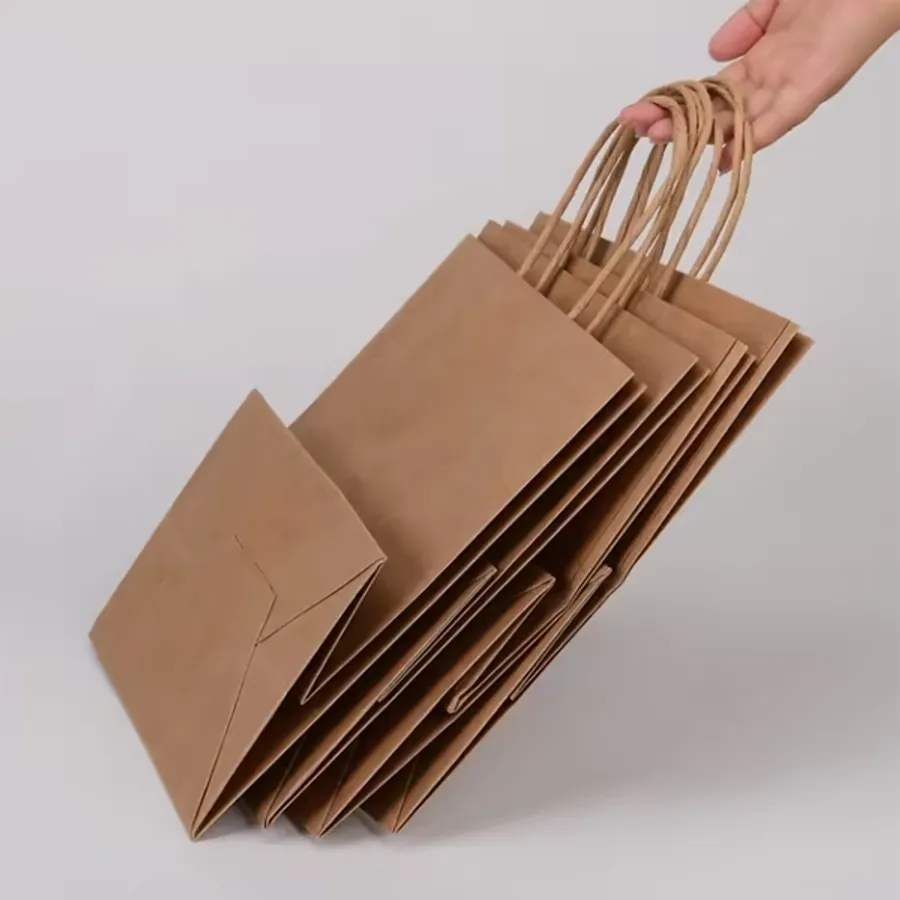
Shops that already have a settled brand can skip the plain stage. One color on kraft is the first printed order for most of them. Our kraft paper bags with handles are the usual bag under it.
How many bags should a new business order?
Without sales history, start from a target. Estimate the number of customers a week, assume most of them take a bag, and order enough for eight to ten weeks.
A boutique expecting 150 customers a week needs around 1,500 bags for ten weeks. Split 60/40 between the medium and small size if you are unsure, then adjust on the reorder. Small single-item bags are on our twisted handle paper bags page.
Err on the lower side for a first printed order and the higher side for plain. Plain bags never go out of date; printed ones do if the logo changes.
Leave room in the budget for a second order within three months. The reorder is where you fix the size mix and move to print, so it is the more important one.
What artwork do you need for a printed bag?
A printed bag needs less than people fear. One clean logo file and a note on the color are enough for a proof. Get these ready before the quote and the proof comes back in one round.
- Your logo in vector form, meaning AI, EPS, SVG or PDF. Ask whoever designed it, because they will have one.
- A one-color version of the logo, since most first printed orders use one ink.
- The brand color as a Pantone number or a hex code, or a photo of your sign if that is all you have.
- Any text to go under the logo: the web address, a social handle or the town name.
- A rough idea of where the logo sits and how large, even a pencil sketch on a bag you own.
- The name and email for the proof, and who approves it if that is not you.
Can you see the bag before you order?
Yes, in two stages. Design Your Bag puts your logo on a photo of a real bag. You resize it and pick the ink, then share the picture with a partner before anything is quoted.
After that, every printed order gets a free design proof from our designers, built from your original file. It shows the exact size, print area and colors, and you approve it before the press starts.
Both stages are free, so there is no reason to order a printed bag unseen. Start with the Design Your Bag photo preview and go from there.
What goes wrong on first orders?
The same handful of mistakes come up again and again from new businesses. None of them is expensive to avoid, and all of them are expensive to fix after the bags arrive.
Sizing from a product photo rather than a tape measure is the big one. The second is ordering a single size to keep things simple, and the third is sending a logo lifted from an Instagram profile.
Timing is the other trap. Count 4–6 business days on the press after proof approval, and 2–3 more in transit. Order inside that window and the shop opens with no bags.
Over-ordering is rarer but more costly. Three thousand printed bags for a shop that uses 80 a week is a year of storage and a logo you cannot change.
Your first paper bag order in seven steps
Here is the whole process in order. Most new customers finish it in a week, with the proof round taking the longest.
- Pick the range from the table above, based on what leaves the shop in the bag.
- Measure your two most common purchases and choose one or two sizes with clearance.
- Decide plain or printed. If the brand is still moving, go plain with a sticker and print on the reorder.
- Estimate eight to ten weeks of bags from your expected customer count.
- Gather the artwork files, or skip this step for a plain order.
- Send the size, quantity, paper, handle and print through the quote form, with your logo attached.
- Check the free proof, approve it, and plan for delivery about two weeks after approval.
What happens after the quote?
The quote comes back in writing with each size as its own line. If you asked for two quantities, both appear, so you can see the unit price change.
Once you confirm, a designer builds the proof. You check the logo size, the spelling and the color, and ask for any changes. Approval starts the press run.
The bags ship flat in cartons with tracking, so you know the delivery day in advance. Open one carton on arrival and check a bag against the proof.
A misprint or damage you report with photos inside 10 days gets a reprint or a refund. For the next order, the approved artwork is already on file, so the reorder takes a single email to our quote request desk.