Paper bag guide
Eurotote Bags: What They Are and When to Choose One
How a eurotote differs from a standard shopper, and which stores get their money's worth from one
What is a eurotote bag?
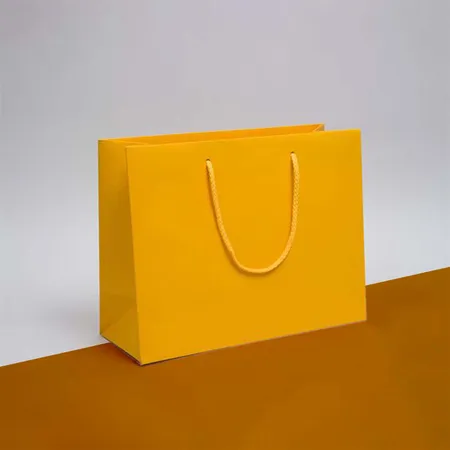
A eurotote is the stiff, glossy or matte shopping bag you get from a fashion store, a jeweler or a cosmetics counter. The name comes from the European boutiques that made the style common in the 1980s.
Underneath the finish it is still a paper bag with side gussets and a square bottom. What changes is the build. Heavy coated paper, a film laminated over the print, rope or ribbon handles, a turned-over top and a card insert in the base.
Each of those parts adds cost and weight. Together they make a bag that stands up on its own, keeps its shape in the hand and gets reused for months.
That reuse is the point. A eurotote is a billboard that customers carry on purpose.
How does a eurotote compare with a standard paper shopper?
The clearest way to decide is to put the two bags side by side. The table compares a typical eurotote with a typical twisted handle kraft shopper of the same size.
| Feature | Eurotote | Standard kraft shopper |
|---|---|---|
| Paper | Coated art paper, 157–210 gsm | Kraft, 120–150 gsm |
| Surface | Matte or gloss lamination over the print | Uncoated paper, ink sits on the fiber |
| Handles | Rope or ribbon, fitted by hand through reinforced holes | Twisted or flat paper, glued in by machine |
| Top edge | Folded over with a stiffening strip | Plain cut edge or a short fold |
| Base | Card insert, flat and square | Paper only, squares out when filled |
| Full color, solid colors, foil, spot UV | One or two colors, full color on white | |
| Cost order | Highest of the shopping bags | Low to middle |
| Typical use | Fashion, beauty, jewelry, gifts, events | Everyday retail, cafés, markets |
Why does the paper and lamination matter?
Coated art paper is smooth and sealed, so the ink stays on the surface instead of soaking in. Colors come out bright and edges stay sharp. That is why a eurotote can carry a solid brand color across the whole bag without blotching.
The lamination is a thin film applied after printing. It protects the ink from scuffs, rain and fingerprints, and it sets the feel of the bag. Matte reads soft and expensive, gloss reads bright and energetic.
On kraft, none of this is possible. Kraft is uncoated, so it drinks ink and mutes color, which is its charm for a bakery and its limitation for a cosmetics brand. Our guide to kraft and white paper covers that trade-off.
If you want the structure of a eurotote without the shine, ask for uncoated heavy paper with rope handles. It is a different bag, but it shares the card base and the turned top.
Rope handles or ribbon handles on a eurotote?
Rope is the standard. A soft cotton or polyester cord is threaded through reinforced holes and knotted inside the top. It is comfortable over a wrist, holds a heavy load and comes in colors to match the bag.
Ribbon is the gift version. A flat satin or grosgrain ribbon is fed through the same holes and knotted or tied in a bow. It looks lighter and more decorative, and it suits jewelry, perfume and wedding gifts.
Choose by weight and by the moment. Clothing, shoes and boxed gifts want rope. A single small box in a bag that is itself part of the present wants ribbon.
Both are fitted by hand, which is part of the cost. The rope handle paper bags page shows the kraft and coated options side by side.
What do the turned top and card base do?
The turned top is the folded rim at the mouth of the bag. Inside it sits a card strip that takes the pull of the handles. The load spreads along the whole top edge instead of tearing at two holes.
The card base is a stiff board cut to fit the bag's footprint. With it in place the bag stands on a counter, a shoebox sits level and the bottom stays flat under load.
Together they are why a eurotote looks as good at the end of a shopping trip as at the start. They also add thickness when the bag is folded flat, so eurototes take more shelf space in the stockroom than kraft shoppers.
Both can be covered to match the bag color on request. It is a small detail that shows when the bag stands open at the till.
Which stores get their money's worth from a eurotote?
A eurotote costs more than any other shopping bag, so it needs to earn its place. It does that where the purchase is high value, the bag is reused and the bag is seen by other shoppers.
Fashion boutiques, shoe stores, jewelers, beauty counters and fragrance brands tick all three. So do galleries, high-end gift shops and wine merchants. Trade show teams and event planners use them for VIP gifts for the same reason.
A café, a grocery store or a hardware counter does not. The bag outlasts the purchase, the customer throws it away and the cost is wasted. A printed kraft shopper does that job better.
A good test is the average sale. If a eurotote would be less than a couple of percent of what is inside it, it fits. Compare the finished bags on our luxury paper bags page.
When is a eurotote the wrong choice?
The style is so good-looking that it gets ordered for the wrong jobs. Here are the cases where we steer customers elsewhere.
- Takeout and food. Lamination traps steam and the card base soaks up spills.
- Low-value, high-volume sales, where the bag costs more than the margin on the item.
- A brand that wants a natural, uncoated look. Kraft with rope handles gives the structure without the shine.
- Very large bags for bulky goods. The card base and rope cannot stop a 20 in bag from flexing when loaded.
- Short lead times. Hand-fitted handles and lamination add steps, so plan on the full production window.
- A tight stockroom. Eurototes fold flat but stack thicker than kraft bags.
What sizes do eurototes come in?
Eurototes follow the same width × gusset × height system as every other bag. Three sizes are common. A small portrait bag for cosmetics and jewelry, a medium portrait for folded clothing and a wide landscape for shoe boxes and gift sets.
A small bag around 8 × 4.75 × 10.5 in takes a perfume box or a jewelry case with tissue. A medium around 10 × 5 × 13 in takes a folded shirt or a candle set. A landscape 16 × 6 × 12 in takes a shoe box flat or a stack of brochures.
Most brands run two sizes in the same color and finish. That keeps the look consistent at the till and lets staff match the bag to the purchase without thinking.
Black is the color we quote most, in matte with a foil logo. Our black paper bags page shows how that combination looks in kraft and in laminated paper.
How do you specify a eurotote for a quote?
A eurotote has more options than a kraft shopper, so a quote request needs a few more answers. Work through these in order and the quote comes back complete.
- Size, as width × gusset × height, and whether the shape is portrait or landscape.
- Background color, as a Pantone number, or white if the design is printed artwork.
- Lamination: matte or gloss. Matte for dark colors and foil, gloss for bright colors and photos.
- Handle: rope or ribbon, and the handle color.
- Print: a logo in one color, full color artwork, or a solid color with a foil, spot UV or embossed logo.
- Inside the bag: plain, or the brand color carried over the top fold.
- Quantity per size, and whether you reorder each season.
What happens after you approve the proof?
Every eurotote order gets a free proof that shows the layout flat and the bag assembled, with the finish and handle marked. Check the color reference and the position of the logo on the front and the back.
Once approved, production takes 4–6 business days. Lamination and handle fitting are part of that window, not extra on top.
The bags ship flat with the card bases packed inside. Tracked transit is 2–3 business days. Open the first carton and check a bag against the proof before the rest go to the stockroom.
Problems reported with photos inside 10 days get a reprint or a refund. Reorders use the same artwork, so a second season's order is a single email.