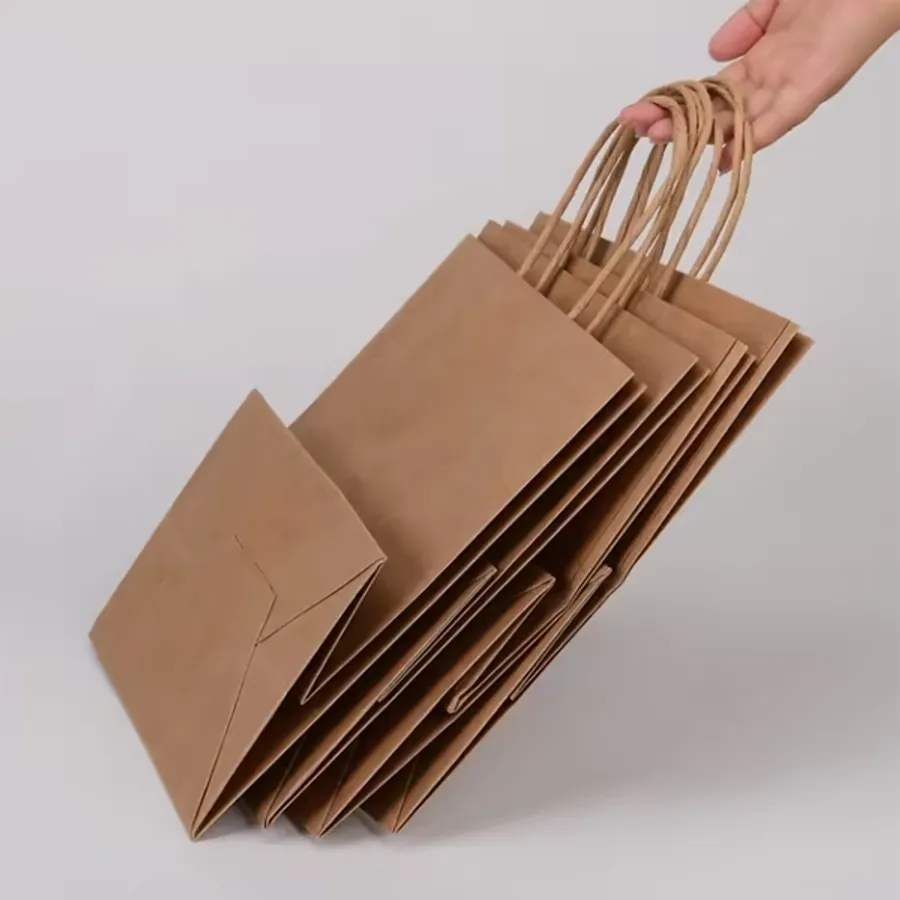
Paper bag guide
How to Measure a Paper Bag: Width, Gusset and Height
Measure width, gusset and height in the right order, from a bag you use or from the product
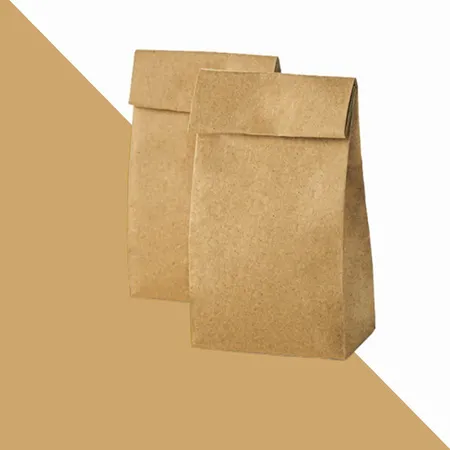
Why are paper bags measured as width × gusset × height?
Boxes are listed as length × width × height. Paper bags are not. A bag is written as width × gusset × height. Mixing the two systems is the most common reason a quote comes back for the wrong size.
Width is the distance across the front panel, from one side fold to the other. Gusset is the depth of the side pleat when the bag is opened square. Height runs from the bottom fold to the top edge, before any handle.
Take a 12 × 7 × 17 in grocery sack. The front is 12 in across, the side pleat is 7 in deep and the paper stands 17 in tall. Opened out, its footprint is a 12 × 7 in rectangle.
Write the three numbers in that order on every quote request and we can read it straight away. A sketch with the three arrows marked removes any doubt.
How do you measure a bag you already use?
The quickest route to the right size is a bag that already works for you. Measure it flat and empty, with a tape measure or a steel rule, and note each figure to the nearest quarter inch.
- Lay the bag flat, folded as it was delivered, with the handles pointing away from you.
- Measure across the front from fold to fold. That is the width.
- Open the bag out so the side pleats stand square. Measure one pleat from front to back. That is the gusset.
- Lay it flat again. Measure from the bottom crease to the top edge of the paper, ignoring handles. That is the height.
- Turn the bag over and check the back matches the front. On a well-made bag it will.
- Note the handle type and whether the top is folded over, because both affect the usable height.
- Write the three numbers as W × G × H, and photograph the bag with the tape in place.
What if you have no bag to copy?
Then measure the product, or the group of products, that goes in the bag. Stack or line up the items the way staff will pack them. Measure the widest side, the depth and the height of the whole stack.
Add clearance so items slide in without tearing the paper or crushing the contents. How much depends on what it is, and the table gives working figures.
Bag width must be more than the widest side of the stack. Gusset must be more than its depth. Height must cover the stack plus clearance plus room to close or carry.
| What goes in | Add to width | Add to gusset | Add to height |
|---|---|---|---|
| Folded clothing, soft goods | 1 in | 0.5 in | 2 in |
| Boxed items, shoe boxes | 1 in | 1 in | 2–3 in |
| Stacked food containers | 1 in | 0.5 in | 3 in for the fold or handle |
| Bottles and jars | 0.5 in per bottle | 0.5 in | 1 in above the cap |
| A loaf, cake or pastry box | 0.5 in | 0.5 in | 2 in to fold the top |
| Flat items: cards, prints, documents | 0.5 in | No gusset needed | 1 in |
Where does the handle fit into the height?
The height figure stops at the top edge of the paper. Twisted and flat paper handles stand above that edge, so the bag is taller in the hand than on the quote.
Rope and ribbon handles hang loosely and add a similar amount. Die-cut handles cut into the top 1.5 in or so of the panel, which reduces the usable height instead of adding to it.
Bags with a turned-over top lose about 1 in of inside height to the fold. Keep that in mind on tall items such as wine bottles or rolled prints.
If the contents need to stay covered, add the full fold height. Our handle types compared guide shows how each handle sits on the bag.
Gusset bags or flat bags: which measurement applies?
A flat bag has no gusset. It is just two sheets of paper joined at the sides and bottom, so it is measured as width × height, two numbers only.
Flat bags suit thin items: greeting cards, a single cookie, a sandwich, a record or a T-shirt. Once an item is more than about 1 in thick, it pulls the sides in and the bag looks strained.
A gusseted bag opens into a box shape. Grocery sacks, shoppers and SOS sacks all have gussets, and the gusset is what gives them a flat bottom.
Some bags have a bottom gusset only, with flat sides. Those are measured as width × height plus the bottom depth. Say which type you mean and attach a photo. Flat sizes are listed on our paper merchandise bags page.
How do you convert inches to centimeters for a bag size?
Mills and overseas suppliers often work in millimeters or centimeters, and some US buyers send metric drawings. The conversion is simple: 1 in equals 2.54 cm.
Multiply inches by 2.54 to get centimeters. A 10 × 5 × 13 in bag is 25.4 × 12.7 × 33 cm. Going the other way, divide centimeters by 2.54.
Round to the nearest half centimeter or quarter inch. Bag making does not hold tighter tolerances than that, and a figure like 25.37 cm only looks precise.
Paper weight has its own conversion between gsm and pounds, and that one is not a straight multiply. The gsm and basis weight guide covers it.
Measuring mistakes that lead to the wrong bag
Most sizing errors come from measuring the right things in the wrong way. These are the ones that reach our quote desk most often.
- Measuring the bag while it is full, which stretches the paper and adds up to an inch on every side.
- Including the handles in the height, so the delivered bag looks short.
- Quoting the gusset as the full depth of the opened bag instead of one side pleat.
- Swapping width and height on a landscape bag, which turns a wide bag into a tall one.
- Measuring one product and forgetting the second item that goes in with it.
- Rounding down instead of up, so the contents fit only when forced.
- Sending a metric figure labeled as inches, or the other way round.
Which bag size should you quote when products vary?
Most stores sell more than one size of thing. Measure the three or four products that go out most often, not the biggest one you ever sell.
Pick a bag that fits the most common bundle with clearance. Then decide whether the largest items need a second size or can share a bigger bag once a week.
Two sizes cover almost every store. One for single or small purchases and one for the everyday larger bundle. A third size only earns its place when a specific product sells daily.
For food service, the containers set the size and nothing else does. Line up the two or three container combinations you pack most and measure each stack. Sizes that fit common containers are on our takeout paper bags page.
What should you send with the measurements?
Three numbers in the right order are enough to quote, but a little more detail saves a round of questions. Send the measurements with a note on what the bag carries and a photo if you have one.
Say which handle you want, because the handle changes the top of the bag. Say whether the top folds over, and whether the bag needs to stand up on a counter. A kraft bag with twisted handles and an open top is the usual retail request.
If you have measured from a product rather than a bag, say so. We then check the clearance against our own figures before the quote goes out.
Measurements can be typed straight into our written quote request form, and a proof follows once the bag style is agreed.
A quick worked example
A candle shop sells a jar 3.5 in across and 4.5 in tall, usually one per customer, sometimes two side by side. It wants a bag with twisted handles and no folded top.
Two jars side by side give a footprint of 7 × 3.5 in and a height of 4.5 in. Adding 1 in to width, 0.5 in to gusset and 2 in to height gives 8 × 4 × 6.5 in.
That is close to a common small shopper of 8 × 4.75 × 10.5 in, which gives extra height for tissue paper. The shop can take the common size or ask for the exact 8 × 4 × 6.5 in bag.
Either answer is fine. The point is that the numbers came from the product, in the right order, with clearance built in.